

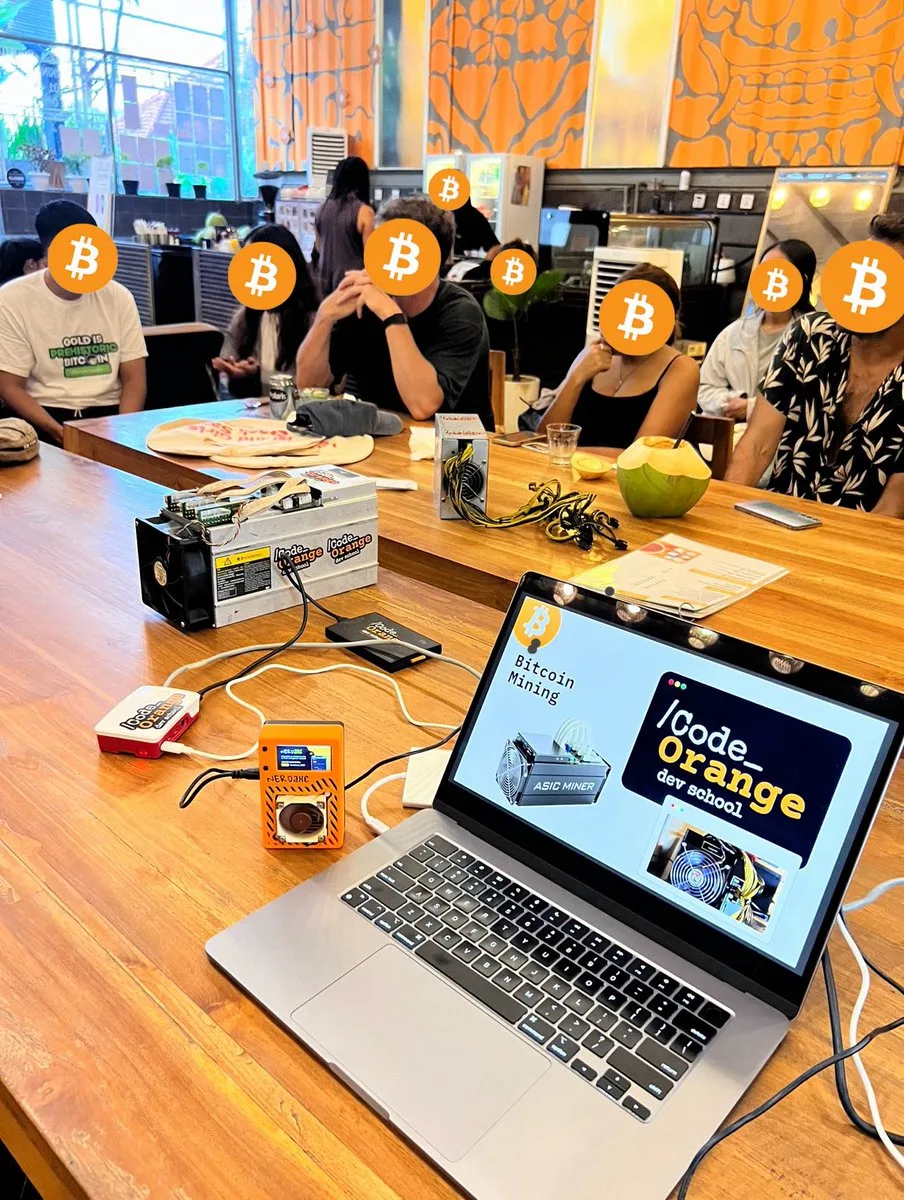
At our Bitcoin mining workshop at Bitcoin House Bali we plugged in a BitAxe from Solo Satoshi, pointed it at the network and made a deal with everyone in the room: if this little machine finds a block before the workshop ends, we split the 3.125 BTC reward between us.
We didn't find a block. You'd have heard about it.
But that deal turned out to be the best way we've found to explain how Bitcoin mining works. This is what a tiny home miner teaches you.
What a BitAxe actually is
A BitAxe is a small, open-source Bitcoin miner. It sits on a desk, runs off a normal power supply and is quiet enough to keep at home. It does the same job as the giant machines in mining farms, just with far less hashpower.
That makes it perfect for a workshop. You can hold it, look at the chip, watch the numbers move on its little screen, and ask "so what is it actually doing?"
Mining is a lottery
Here is the simple version we give at every session.
Miners collect waiting transactions from the mempool and pack them into a block. To add that block to the chain, they have to find a number that makes the block's hash come out below a target. There is no shortcut. You just guess, billions of times, as fast as you can. That's proof of work.
Every guess is a lottery ticket. The big farms buy millions of tickets per second. Our BitAxe buys far fewer. But every ticket has the same chance, so a home miner can win. It's just very unlikely on any given night. That's why our "split it" deal was safe, and also why it was fun: the chance was small, but it was never zero.
Why the target keeps moving
The next question is always: "If more miners join, don't blocks get found faster?"
For a while, yes. Then Bitcoin adjusts. Every 2,016 blocks the network looks at how fast blocks came in and makes the target easier or harder, so blocks keep arriving about every ten minutes. That's the difficulty adjustment, and it came up again and again at our Bitcoin Basics calls. It is the reason nobody can print Bitcoin faster by buying more machines.
Pools: buying tickets together
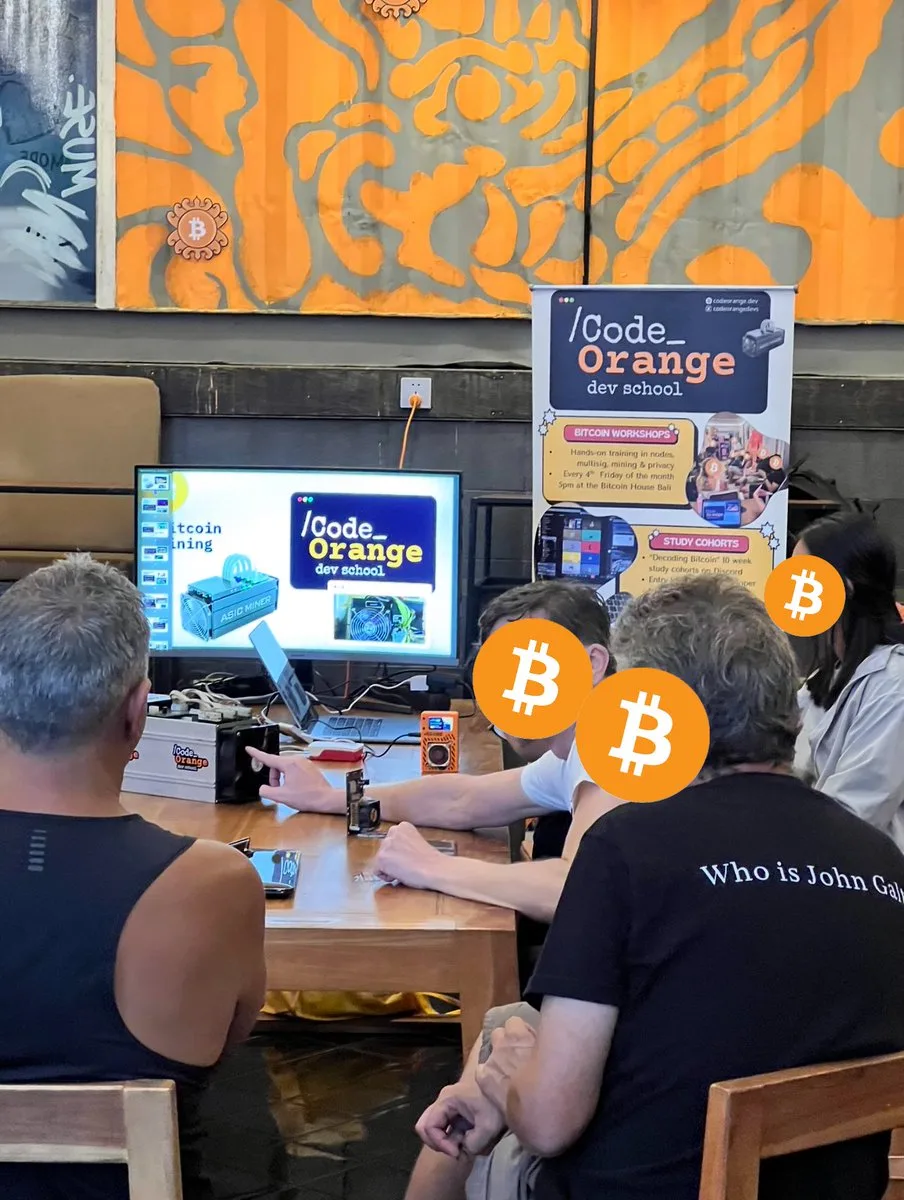
Most home miners don't play the lottery alone. They join a mining pool, add their hashpower to everyone else's, and get a small, steady share of the rewards instead of a tiny chance at a big one.
In our September 2026 Bitcoin Basics session we looked at Ocean as a pool and at Braiins for hashpower. A good question to ask any pool is: who picks the transactions that go into the block? If a few pools decide that for most of the network, that's a centralisation risk. That's what newer protocols like Stratum V2 try to fix, by giving miners more say over what they mine.
Mining is about energy
As we put it in a reply on X last year: running a BitAxe teaches you about mining, about energy "transportation", and about your own contribution to the network.
Mining turns electricity into security. Bitcoin is money bounded by energy: to rewrite history you'd have to redo the work, and that work costs real power. In our May 2026 session, hosted by Razor, we spent a lot of time on exactly this: energy, mempools, mining pools and whether home mining can ever be profitable. (Short answer: mostly not, if you only count the sats. People run a BitAxe to learn, to support the network and sometimes to heat a room.)
So what can a 51% attacker do?
Once people understand proof of work, the scary question comes up: what if someone controls more than half the hashpower?
It's a great discussion. A majority miner could reorder or censor recent transactions, or try to double-spend their own coins. What they can't do is break the rules every node checks. They can't create coins out of thin air, raise the 21 million limit or spend your coins without your keys. Your node would simply reject those blocks. That's where mining and running a node meet.
Every pleb should run a BitAxe or a node
We've now taught mining in Bali, on Discord, in Chiang Mai at the Bitcoin Learning Centre, and with miners on the table at summits. The pattern is always the same. Someone picks up the BitAxe, asks what it's doing, and twenty minutes later they understand blocks, difficulty, pools and why Bitcoin is so hard to attack.
You don't need to buy a miner to learn this. But if you have one, bring it.
Join the next one
Mining is part of our Bitcoin Basics workshops, online on Discord and in person in Bali. Check the calendar for the next session, see all our programs, and say hi on Discord. Want to read more first? Our resource library has every link we've shared in past sessions.
If our BitAxe ever does find a block, we'll keep our promise.
This article started as a few posts on our X account. The originals: 27 Sep 2025 · 29 Jul 2025 · 1 Mar 2025 · 13 May 2026 · 2 Sep 2026 · 3 Sep 2026.