
Full recording, 79 min. Plays from youtube-nocookie.com. Watch on YouTube
Jump to a chapter (20 chapters)
- Intro: reading the whitepaper together
- The first line: peer-to-peer, no financial institution
- What did Satoshi mean by "electronic cash"?
- Bitcoin as the ultimate bearer asset
- Digital signatures and the double spending problem
- Peer-to-peer network: node runners are the police
- Timestamps, hashing and the chain of proof of work
- The airplane analogy: how all the parts fit together
- Should you spend your Bitcoin? Spend and replace
- The longest chain and the 51% attack
- CPUs, GPUs and ASICs: how mining changed
- Why run your own node?
- "Minimal structure" and best-effort broadcasting
- Discussion: the paper's core proposal
- Proof of work, energy and game theory
- Why signatures are only part of the solution
- Why the largest pool of CPU power matters
- Nodes leave and rejoin at will
- Why a timestamped chain and not a plain list?
- Wrap-up and what's next
TL;DR
- The key line: peer-to-peer cash, without going through a financial institution.
- Signatures prove you own coins, but they can't stop you paying the same coins twice. The network does that.
- Proof of work plus the longest chain decide which history is true, so rewriting it would take most of the world's hash power.
- Spend some bitcoin and buy it back. A coin that never moves ends up like gold in a vault.
Play the abstract
Six sentences, six levels. Pick an answer to unlock the next line of the whitepaper and earn XP. Everything here comes from what we discussed on the call.
Highlights
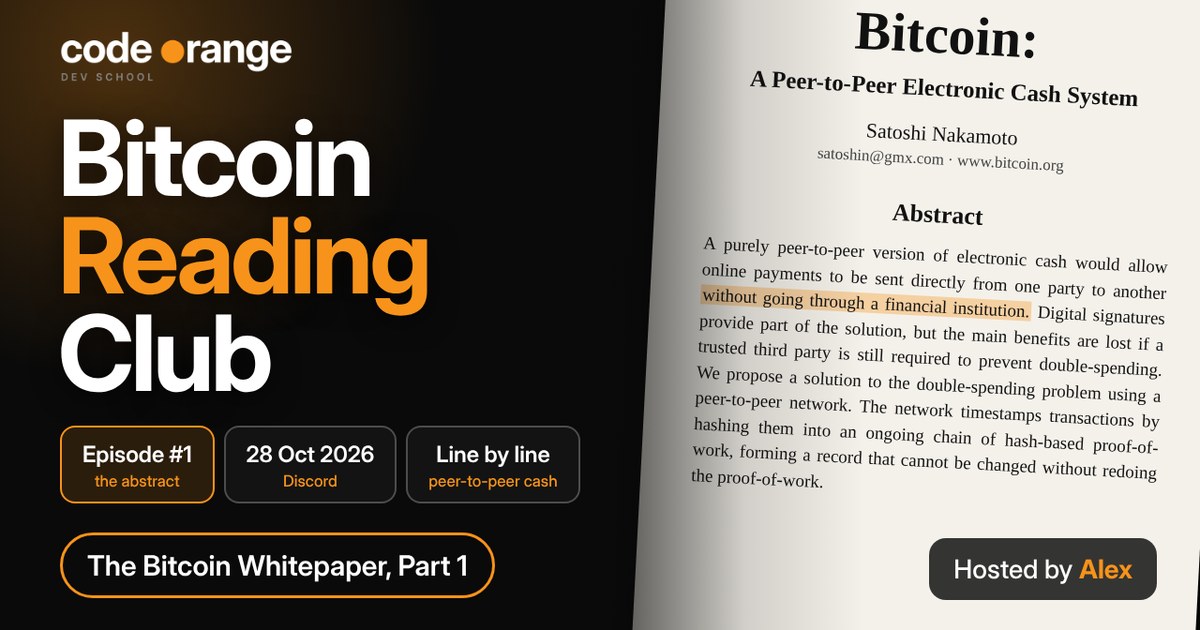
One sentence that started it all. Alex opened the whitepaper on an annotated reading site and went through the abstract one sentence at a time. The first line got the most time: “A purely peer-to-peer version of electronic cash would allow online payments to be sent directly from one party to another without going through a financial institution.” It is the reason Bitcoin is so hard to ban. As long as two people want to trade, there is no middleman to shut down.
“Peer-to-peer is the way to get it, the way Satoshi intended it to be.”
Alex, on where to get your first bitcoin
1The abstract in five steps
What each sentence adds
From a problem to a working system
- Signatures already worked before Bitcoin. They prove a payment came from you.
- But digital things copy easily. You could sign the same coin over to ten people at once. Paper cash can only be handed to one.
- So the network keeps one shared, time-ordered ledger, chained together with proof of work, and every node follows the chain with the most work behind it.
The airplane: Bitcoin is the plane, proof of work is the engine, the blockchain is the wings, the peer-to-peer network and cryptography are the cabin. A blockchain on its own is just a metal dining table. It only flies with every part together.
⚔Mini-game: try to double spend
You have one coin. Try to pay both shops with it. First with signatures only, then with the Bitcoin network.
Pick a shop to pay.
2Should you spend your bitcoin?
A question from the chat: if bitcoin is a savings asset, doesn’t spending it mean losing future value? The answer from the room was spend and replace. Pay for small things in bitcoin, then buy the same amount back. Merchants only accept bitcoin if people pay with it, and coins that never move end up like gold: locked in vaults while a credit system runs on top.
SpendSmall, everyday amounts. It keeps the circular economy going.
ReplaceBuy it back right away, so price moves barely matter.
SaveKeep the rest. You don’t have to spend all of it.
Key takeaways
1. “Cash” means final, not small. Some read “electronic cash” as coffee payments on-chain. Another reading: cash is the opposite of credit. Once paid, it can’t be reversed, and nobody else’s promise stands behind it. That makes bitcoin a bearer asset: control the keys, and you own it. Lightning and ecash now handle the small, fast payments on top.
2. Node runners are the police. Every node checks every rule. Running your own means you verify the bitcoin you receive is real and you choose the software and rules you support. Nodes can leave and rejoin at will and simply catch up on the longest chain. No central server, no choke point, like mycelium under a forest.
3. Energy is the security. Miners chase rewards with better machines (CPU, then GPU, then ASIC). That greed is what makes rewriting history so expensive that a big company couldn’t just break Bitcoin for fun.
Mining hardware
Built for one job: hashing. Fast to upgrade, fast to lose value.
5 nm chips and belowGraphics cards turned out great at parallel hashing.
Early 2010sThe whitepaper’s “CPU power”. Every node was also a miner.
2009Hope from the call: as chip gains flatten out, home miners stay useful for longer, which is good for decentralization.
Word bank
The words from the call, in plain English. Tap a card to flip it.
Resources shared
Reading
- Bitcoin: A Peer-to-Peer Electronic Cash System, Satoshi Nakamoto, 2008: the whitepaper itself. We covered the abstract; chapter 1 (Introduction) and 2 (Transactions) are next
- Bearer instrument: an asset where holding or controlling it is what proves you own it. We looked up the definition on the call
- Byzantine fault (the Byzantine Generals Problem): the coordination problem proof of work solves without a central party
Tools
- Bitcoin Core: run your own node to check the bitcoin you receive is real and choose which rules you enforce
Code Orange
- Decoding Bitcoin cohort: 10 weeks on how Bitcoin works under the hood, including the signatures and hashing from the abstract. Starts Monday 16 November
- Bitcoin Basics: beginner meetup, next one Thursday 5 November
Ideas for next time: simpler discussion questions, a sats quiz with prizes, then chapter 1 (Introduction) and chapter 2 (Transactions) of the whitepaper.
These notes are also on GitHub: code-orange-dev/session-notes. Free to share and reuse (CC0).