
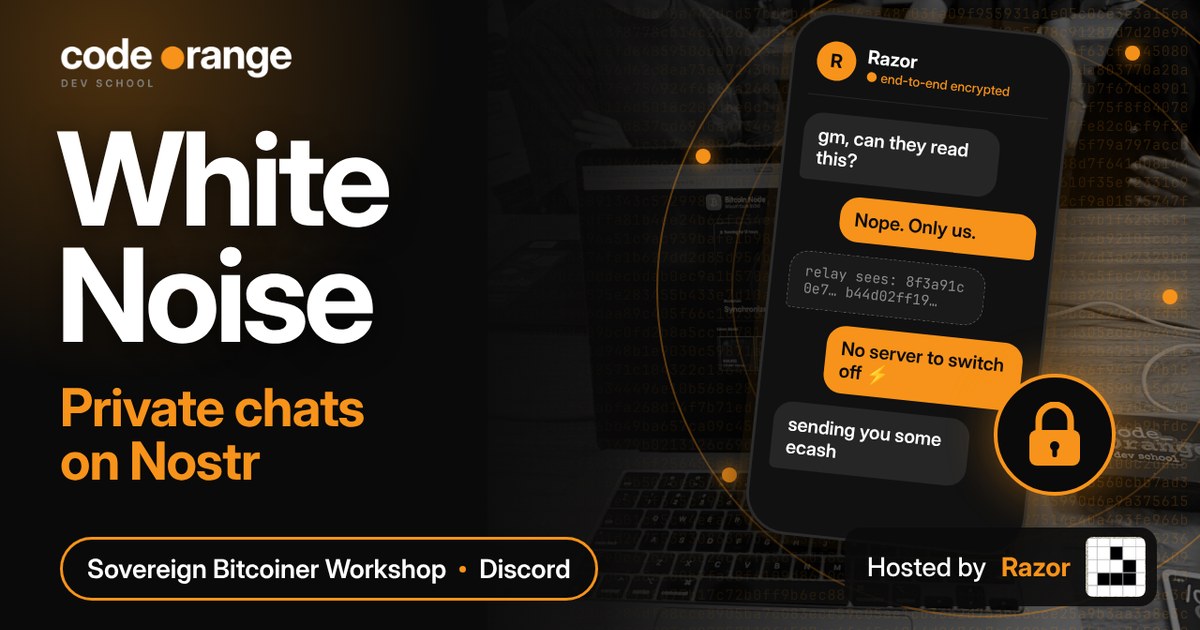
Full recording, about 90 min. Plays from youtube-nocookie.com. Watch on YouTube
TL;DR
- Every chat app needs something in the middle to hold your messages while you are offline. The question is who runs it and what it can read.
- Encrypting is the easy part. The hard part is two people agreeing on a key over a line anyone can watch, and knowing the key really belongs to your friend.
- White Noise keeps the encryption (MLS) and swaps the company server for Nostr relays that anyone can run, so there is no single off switch.
- Old-style Nostr DMs hide the text but show who messaged whom and when. Gift wrap is the fix, and it is still being finished.
Mission board0 XP
Don’t just read it. Play it.
Five mini-games on this page, one for each big idea from the workshop. Finish one and its badge lights up. Your progress is saved on this device.
Highlights
1Why is there always a server in the middle?
Razor started from zero. You might think two phones with the same app just talk to each other. They can’t, because one of them is often asleep, offline or out of battery. So something in the middle has to hold the message until the other phone wakes up. For most apps, that something is a company’s server.
Then comes the real question: what can that server read? Flip the switch and watch the middle box.
Try itWho can read your message?
gm, coffee at 7?gm, coffee at 7?gm, coffee at 7?2The hard part: agreeing on a key
“Encrypting is very easy. The hard part is the key exchange.” You and your friend need the same secret key, but the only line between you is one that anyone can watch. The classic answer is the Diffie-Hellman key exchange, and every modern chat protocol is built from it. Razor explained it with paint, so here is the paint.
Game 1 and 2The paint lab
Mix a secret in public ✓
Pick a secret colour for Alice and for Bob, then mix. Everything in the middle column is public: the spy sees all of it.
Alice’s secret
Bob’s secret
Aliceher phone
The open lineeveryone can see this
Bobhis phone
Where the picture breaks: with real paint, a clever spy could work out what was added. The real thing uses maths that only goes one way, so seeing both mixed jars gets the spy nowhere.
Good question from the room
“Why not just encrypt with my friend’s public key?”
You can. Lock a message with Bob’s public key and only Bob’s private key opens it. (Not the other way round: lock it with your own private key and everyone can open it. We untangled that one live.) But this kind of encryption is slow, and easy to get wrong for photos and long chats.
So in practice: use the slow maths once to agree on a shared key, then use fast encryption for everything after. Good protocols also keep changing that key, so one leaked key doesn’t open your old messages.
3Trust on first use, and how to catch a spy
Did you try “Spy swaps the jars” above? That is a man-in-the-middle attack. Alice and Bob both end up with a key, they just don’t share it with each other. They share it with the spy, who reads everything and passes it along.
The first time you message someone, you simply trust that the key you got is theirs. It even has a name: TOFU, trust on first use. The fix in Signal and WhatsApp is the safety number (or QR code): a short fingerprint of your shared key. Meet in person, compare, and if the numbers match, nobody is in the middle. Nostr has the same problem in a different shape: you need to be sure the npub you are messaging is really your friend’s.
4Now take the company away
Signal’s encryption is great. But Signal, WhatsApp and Telegram each run on one company’s servers. A government can lean on that company, block it, or the company can decide your country is no longer welcome. Razor’s example was his own: imagine Romania turning authoritarian in ten years and ordering the apps off.
White Noise keeps the good part (the encryption) and replaces the company server with Nostr relays. Your app sends each message to several relays. They hold it until your friend comes online. Anyone can run a relay, so there is no single door to close. Try closing it.
Game 3Switch it off
You are the censor. Stop this message. ✓
Bob is asleep. Alice wants to send him a message and then go to sleep herself. Tap servers to shut them down, then press send.
Under the hood, White Noise is a stack of open pieces. Nothing in it belongs to one company.
What White Noise is made of
The app on your phone or desktop. Chats and groups.
The appThe glue. Says how keys and group messages are stored and passed around on Nostr.
ProtocolThe key exchange and encryption, built for groups. An open internet standard, RFC 9420.
EncryptionRelays hold the small encrypted messages. Blossom servers hold big things like photos and files.
Delivery and storageWorth knowing: relays are run by volunteers and nothing forces them to keep your messages forever. That is why apps send to several at once.
5The experiment: our own relay
Razor wanted to see what White Noise really sends. So he put his own relay on the internet (strfry, set up with help from an AI assistant, plus a tiny plugin that logs every event) and told White Noise on his phone and desktop to use only that relay.
# set both apps to use only wss://my-relay.example
event kind 10002  "here are the relays I use"
event kind 10050  "send my private messages here"
event kind 1059   gift wrap: sealed, unreadable

# now send "hi" from desktop to phone...
(nothing new arrives)
The relay was alive and the apps announced it, but the test chat never showed up on either side. Razor’s best guess: White Noise fixes the relay list when a chat or group is created, so changing relays later only affects new chats. It is a guess, not a confirmed answer. As he put it about the app’s security audit, finding issues is a good thing. It means someone looked.
6What can a relay see?
Alex then showed something that surprised half the room. He logged into Primal using only someone else’s public key. Read-only, nothing hacked. He could see every account that had sent that person an old-style Nostr DM, and when. He could not read the text. But who talks to whom, and when, is often the sensitive part.
Gift wrap (the kind 1059 events from Razor’s log) is the fix: the real message is sealed inside an envelope signed by a throwaway key with a fuzzed date. Write a message and look at it the way a relay does.
Game 4Be the relay
What leaks? ✓
Honest status from the call: private messaging on Nostr has been rebuilt more than once and is still work in progress. Gift wrap is the newest design, not the final word.
7And then: money in the chat
The question that kept coming back: when can we send sats inside the chat? Ecash is a natural fit, because an ecash token is just a string of text. Any chat app can carry it.
- BitChat already does this nicely. It works over Bluetooth with people nearby, no internet at all, and shows a pasted ecash token as a tidy card instead of a wall of characters. Good for places where the internet is censored or simply down.
- White Noise has no wallet built in today. Nobody on the call knew the roadmap, so we want to invite someone from the project to tell us.
- Others are experimenting with ecash on top of Signal-style and Marmot-based chats. Keychat came up too. BitChat and ecash each get their own session.
| App | End-to-end by default | What sits in the middle | One off switch? |
|---|---|---|---|
| Telegram | No, only “secret chats” | Telegram’s servers | Yes |
| Yes (Signal protocol) | Meta’s servers | Yes | |
| Signal | Yes | Signal’s servers | Yes |
| White Noise | Yes (MLS) | Nostr relays, pick your own | No |
| BitChat | Yes (Noise) | Nothing: Bluetooth, phone to phone | No |
Swipe the table sideways to see every column.
“I just want to send the messages, send the ecash, and sleep well at night knowing my messaging app cannot be switched off.”
From the callKey takeaways
1. Encryption is solved. Trust and control are not. The lock on your messages is strong in every serious app. What differs is who holds the door: one company, or a network anyone can join.
2. Check the key, not just the name. A chat can be perfectly encrypted to the wrong person. Compare safety numbers in Signal, and double-check an npub through a second channel before you trust it.
3. Metadata talks. Hiding the text is not enough if the world can see who you message and when. Ask that question of every app you use.
4. These tools need users, not only builders. White Noise, BitChat and friends are young. Trying them, breaking them and reporting what you find, like Razor’s relay test, is a real contribution.
Boss level
Six questions, straight from the workshop. Beat it to earn the last badge.
Word bank
The words from the call, in plain English. Tap a card to flip it.
Resources shared
Apps
- White Noise: the messaging app we tested: end-to-end encrypted chats and groups that travel over Nostr relays instead of one company's servers
- BitChat: chat over Bluetooth with people nearby, no internet needed. It can also show an ecash token as a tidy card instead of a long string
- Keychat: another Nostr chat app that mixes messaging and ecash. Mentioned at the end, saved for a later session
- Signal: what is a safety number?: the number (or QR code) you compare with a friend to check nobody is sitting in the middle of your chat
Protocols
- Messaging Layer Security (MLS), RFC 9420, IETF, 2023: the open standard White Noise uses to agree on keys, including in group chats
- Marmot protocol: the glue between MLS and Nostr: how keys and group messages are stored and passed around on relays
- NIP-59: Gift wrap: wraps a message so relays can't tell who sent it or exactly when. The kind 1059 events we saw on the relay
- NIP-44: Encrypted payloads: the encryption used inside the gift wrap
- Noise Protocol Framework: the key exchange building blocks BitChat uses, built on Diffie-Hellman
Tools
- strfry: the Nostr relay software Razor ran for the experiment. It supports small plugins, which he used to log every event that arrived
- Blossom: simple media servers for Nostr. Photos and files go here, short messages go to relays
- Primal: Nostr client used for the demo: log in read-only with anyone's public key and see who sent them old-style DMs
Watching
- Computerphile: Razor's pick for going deeper: look for their videos on Diffie-Hellman, end-to-end encryption, the Signal protocol and group messaging
Ecash
- Cashu: ecash for Bitcoin. A token is just a string of text, so any chat app can carry it
- Fedimint: community-run ecash mints. On the Privacy Track list after Silent Payments
Code Orange
- Privacy Track: next up: Silent Payments on Tuesday 17 November, then ecash and Fedimint
- Decoding Bitcoin cohort: 10 weeks, every Monday, starting 16 November. Nothing to prepare for week 1
Also mentioned without a link: White Noise has had a security audit, an ecash hackathon is running this November, and people are experimenting with ecash inside Signal-style and Marmot-based chat apps. Saved for later sessions: BitChat, ecash and Keychat.
These notes are also on GitHub: code-orange-dev/session-notes. Free to share and reuse (CC0).